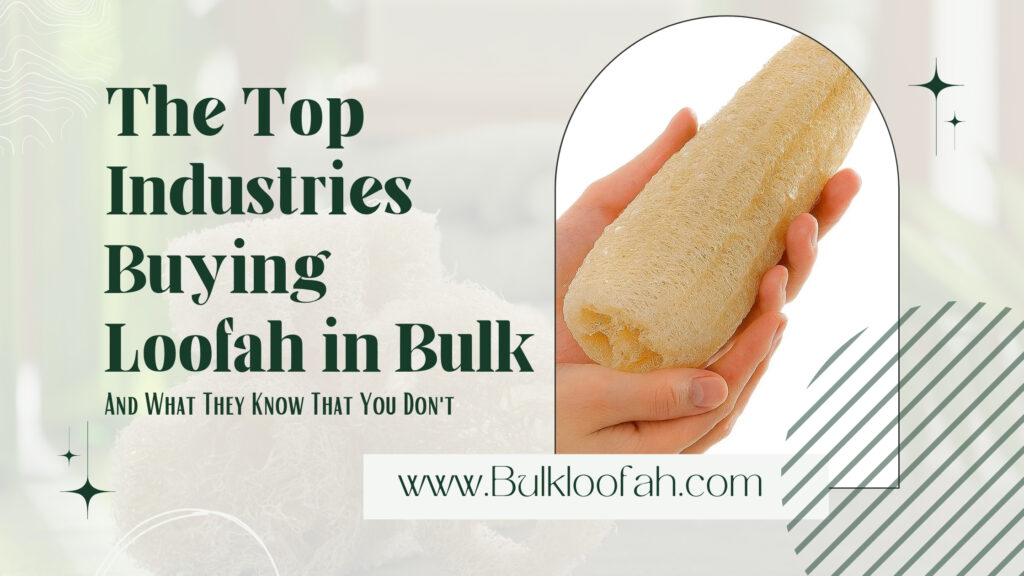
The buyers of natural loofah are not who most people expect. While bath and body care remains the most visible use for natural loofah, the industries buying loofah bulk wholesale today span far beyond the bathroom aisle. Hospitality chains, pet care brands, industrial cleaning companies, eco-packaging startups, and even automotive detailing operations are placing large-scale loofah orders, and they are doing it for reasons that reveal powerful insights about where the natural products market is heading.
If you are a wholesaler, retailer, or brand builder exploring new product categories, understanding which industries are investing heavily in bulk loofah procurement gives you a strategic advantage. You learn where demand is growing fastest, which product specifications matter most, and how to position your own offerings for maximum return. If you are an individual consumer or eco-conscious shopper, this same knowledge helps you understand why quality varies so dramatically between products and how the loofah in your shower connects to a much larger global supply chain.
This article breaks down the major industries purchasing loofah at wholesale scale, explains what makes Egyptian loofah the preferred choice for serious buyers, and shares practical insights you can use whether you are sourcing 50,000 units for a hotel chain or picking out your next kitchen scrubber. You will find comparison tables, industry-specific specifications, supplier evaluation criteria, and answers to the most common questions about bulk loofah procurement.
Ready to explore sourcing options now? You can request a wholesale quote from Egexo or browse the full product catalog to see available formats.
Why So Many Industries Are Buying Loofah in Bulk Wholesale
The shift toward natural, biodegradable, and sustainably sourced materials has moved from niche trend to mainstream business strategy. Regulatory pressure on single-use plastics, consumer demand for eco-friendly products, and corporate sustainability mandates have created a perfect environment for natural loofah to enter industries that never considered it before.
The Sustainability Factor Driving Bulk Demand
Governments across Europe, North America, and parts of Asia have implemented bans or heavy restrictions on synthetic sponges and single-use plastic cleaning products. These regulations push procurement managers to find natural alternatives that perform well and scale reliably. Loofah checks both boxes. It is 100 percent biodegradable, grows renewably in tropical and subtropical climates, and requires minimal processing compared to synthetic alternatives.
For everyday consumers, this same sustainability factor explains why more stores carry natural loofah options and why those options have improved in quality over the past several years. As industries buying loofah bulk wholesale have demanded higher standards, suppliers have responded with better cultivation, processing, and grading practices that benefit everyone, including the person buying a single loofah at a local shop.
The Cost Advantage of Wholesale Natural Loofah
Beyond sustainability, bulk loofah offers a compelling cost profile. A high-quality natural Egyptian loofah can cost less per unit at wholesale volumes than many synthetic alternatives when you factor in the full lifecycle. Natural loofahs carry the added marketing value of being natural and compostable.
For a deeper look at how quality standards affect these economics, review the Egexo quality standards page which explains how products are checked before packing.
The Major Industries Buying Loofah Bulk Wholesale in 2026
Understanding who is buying and why they are buying helps both wholesale buyers identify opportunities and consumers appreciate the variety of loofah products available today.
Hospitality and Hotel Chains
The hospitality industry represents one of the fastest-growing segments of industries buying loofah bulk wholesale. Hotels, resorts, and cruise lines are replacing synthetic bath amenities with natural loofah products as part of broader sustainability programs.
What hospitality buyers prioritize is consistency. Every loofah placed in a guest room must look, feel, and perform identically. This is why hospitality procurement teams focus heavily on supplier quality control and favor Egyptian loofah from established suppliers like Egexo, whose farm to export process is described step by step. Every product is checked by hand for quality, size and dryness before packing. EGEXO has been exporting Egyptian loofah since 2015.
For consumers, this hospitality trend explains why you increasingly find high-quality natural loofahs in hotel bathrooms. That loofah you enjoyed at a resort can often be purchased directly through specialty retailers or from the same suppliers that serve the hotel industry. Browse the bath and body loofah collection to find loofah of the kind used in hospitality.
Spa and Wellness Centers
Spas and wellness facilities have used natural loofah for decades, but the scale of purchasing has expanded significantly. Modern wellness centers use loofah products not only for body scrubbing treatments but also as part of branded retail lines, subscription boxes, and wellness kits they sell to clients.
Spa buyers care deeply about fiber texture and density because their clients have direct skin contact during professional treatments. Coarse or inconsistent fibers can cause irritation and negative reviews. This sensitivity to quality is one reason the spa industry overwhelmingly favors Egyptian loofah, which is soft and gentle from the first use.
If you are a spa owner exploring private label loofah manufacturing, creating your own branded loofah line can generate recurring revenue and strengthen client loyalty.
Kitchen and Household Cleaning Products
Natural kitchen loofahs have seen a surge in demand as consumers and commercial cleaning companies seek alternatives to plastic-based scouring pads. The kitchen segment is particularly attractive for wholesale buyers because it represents a consumable product with short replacement cycles and high repeat purchase rates.
Commercial kitchens in restaurants, cafeterias, and food processing facilities are also adopting natural loofah scrubbers for surfaces where chemical residue from synthetic pads is a concern. A natural loofah leaves no microplastic particles and rinses clean without chemical agents, making it suitable for food contact surfaces.
For home users, natural kitchen loofahs offer the same scrubbing performance as synthetic pads for dishes, countertops, and vegetables. They can be composted when worn out, making them one of the simplest zero-waste swaps available.
Pet Care and Grooming
Pet care brands buy natural loofah grooming pads and bath scrubbers for pets.
Pet brands ordering from the pet and spa grooming loofah category typically request custom shapes, sizes, and densities tailored to specific animal types. This customization capability is one reason established suppliers with custom product design services have seen sharp increases in pet industry orders.
Industry-by-Industry Comparison: How Loofah Specifications Differ Across Buyers
Different industries require different product specifications. The following table breaks down how major buyer categories compare in their loofah requirements.
Different industries need different product formats. EGEXO offers the full range of loofah products. Review the complete product catalog to see the full range of available formats.
For consumers, this helps explain why two loofahs can look similar but feel completely different. A loofah designed for kitchen scrubbing has denser, coarser fibers than one designed for facial exfoliation. Knowing the intended application helps you choose the right product for your needs.
What These Industries Know About Loofah Quality That Most Buyers Miss
The industries buying loofah bulk wholesale at the highest volumes have learned quality lessons through years of procurement experience. These insights apply equally to wholesale buyers placing their first order and consumers selecting a single product.
Why Egyptian Loofah
Egyptian loofah is soft and gentle from the first use, with a looser fiber weave than Asian loofah. Procurement professionals verify quality through sample testing before committing to orders.
EGEXO has been exporting Egyptian loofah since 2015. Our loofah comes from our own farms and partner farms in the Nile Delta and is processed in our own factory. Read the steps on our farm to export, page.
Compare Products, Not Just Price
Experienced buyers compare the full product, not just the price. A low price on a poor-quality loofah is not a better deal if your market demands good quality.
Quality Evaluation Checklist for Bulk Loofah Buyers
| Evaluation Criteria | What to Check | Why It Matters |
|---|---|---|
| Fiber uniformity | Consistent density across the entire surface | Prevents rough spots that cause skin complaints |
| Color consistency | Natural tan to light cream, no dark spots | Indicates proper drying and absence of mold |
| Structural integrity | No tears, holes, or thin patches | Ensures product lasts through expected lifecycle |
| Moisture content | Dry at time of packing | Prevents mold growth during shipping and storage |
| Seed removal | Complete removal with no fragments remaining | Avoids customer complaints about debris |
| Odor | Clean, neutral, slightly earthy smell | Chemical or musty odors indicate processing issues |
| Flexibility | Softens quickly when wet, firms when dry | Confirms proper fiber maturity at harvest |
| Size accuracy | Matches the stated dimensions | Ensures packaging compatibility and customer expectations |
| Packaging integrity | No tears, moisture damage, or crushing | Protects product through distribution chain |
| Certifications | ISO management system certificates and export documents | Supports marketing claims and regulatory compliance |
This checklist works whether you are evaluating a 20,000 unit shipment or inspecting a single loofah before purchase at a store. For wholesale buyers, requesting samples from EGEXO before committing to a large order lets you apply this checklist firsthand. Samples are paid and the buyer pays shipping; the sample cost is credited to your first order of $1,000 or more, placed within 60 days.
How to Enter the Bulk Loofah Market as a New Buyer
If the growth across these industries has caught your attention, entering the bulk loofah market is more accessible than many new buyers expect. The following process outlines the steps from initial research to first shipment.
Step-by-Step Bulk Loofah Procurement Process
| Step | Action | Details | Timeline |
|---|---|---|---|
| 1 | Identify your target market | Choose which industry segment or consumer audience you will serve | Week 1 |
| 2 | Research product specifications | Determine grades, sizes, formats, and packaging needed for your market | Week 1 to 2 |
| 3 | Request supplier samples | Order samples from 2 to 3 suppliers including Egexo to compare quality | Week 2 to 3 |
| 4 | Evaluate samples against checklist | Use the quality evaluation criteria above to score each supplier | Week 4 |
| 5 | Request formal quotations | Provide exact specifications and quantities to get accurate pricing | Week 4 to 5 |
| 6 | Negotiate terms and MOQ | Discuss minimum order quantities, payment terms, and shipping options | Week 5 to 6 |
| 7 | Place initial trial order | Start with a smaller first order to validate the full supply chain | Week 6 to 8 |
| 8 | Inspect received goods | Verify quality, packaging, and documentation against order specs | Week 10 to 12 |
| 9 | Scale with confidence | Increase order volumes based on market response and supplier performance | Month 4 onward |
At EGEXO there is no minimum order on standard products. Private label starts from 1,000 units (up to 2,000 by customization). Request a quotation to discuss your specific requirements.
Why Consumers Benefit from More Industries Entering the Market
When more businesses enter the bulk loofah market, consumers benefit directly. Increased competition among brands drives product innovation, improves quality standards, and makes natural loofah products more widely available. Five years ago, finding a premium Egyptian loofah meant searching specialty retailers or ordering online from niche shops. Today, thanks to the expansion of industries buying loofah bulk wholesale, you can find quality natural loofah products in mainstream retail, subscription services, hotel gift shops, and pet stores.
Emerging Industries and Future Growth in Bulk Loofah Demand
Beyond the established sectors, several emerging industries are beginning to place significant bulk loofah orders, signaling where the next wave of growth will come from.
Automotive and Industrial Detailing
Professional detailing companies use natural loofah for applying wax, buffing surfaces, and cleaning textured materials like leather and vinyl. The natural fiber provides effective cleaning action without scratching, which makes it preferable to many synthetic alternatives for high-value surfaces.
Arts, Crafts, and Education
The raw, unprocessed form of loofah has become popular in arts and crafts, floral arrangements, and educational settings. Teachers use cross-sections of raw loofah scrubbers to demonstrate plant fiber structures, while crafters incorporate loofah into wreaths, soap dishes, and decorative projects. This segment may not match hospitality volumes, but it represents steady, year-round demand with strong margins.
See our wholesale prices on egexo.com: request a quote.
To explore how Egexo supports brand builders with competitive wholesale pricing across these segments, see our products or learn why buyers choose EGEXO.
FAQ Section
Q1: Which industries are the largest buyers of bulk wholesale loofah?
A: The largest industries buying loofah bulk wholesale include hospitality and hotel chains, spa and wellness centers, kitchen and household cleaning product companies, pet care brands, and e-commerce retailers. Hospitality represents the highest volume segment, with large chains placing regular large orders. The pet care sector is one of the newer entrants to the market.
Q2: Why is Egyptian loofah preferred by bulk wholesale buyers?
A: Egyptian loofah from the Nile Delta region has a looser fiber weave than Asian loofah, so it is soft and gentle from the first use. Professional buyers also value consistent quality across large production runs. EGEXO has been exporting Egyptian loofah since 2015.
Q3: What is the minimum order quantity for buying loofah in bulk?
A: At EGEXO there is no minimum order on standard products. Private label starts from 1,000 units (up to 2,000 by customization). Samples are paid and the buyer pays shipping; the sample cost is credited to your first order of $1,000 or more, placed within 60 days.
Q4: How can consumers tell if a loofah is high quality?
A: High-quality natural loofah has uniform fiber density with no thin patches or holes, a consistent tan to cream color, no musty or chemical odor, and softens quickly when wet while maintaining structure. It should bounce back after being squeezed and show no remaining seeds or debris inside the fibers.
Q5: How do I care for a natural loofah?
A: Rinse thoroughly after each use and allow the loofah to dry completely between uses. Replace it when it starts to break down. Natural loofah is fully biodegradable and compostable.
Q6: What certifications should wholesale loofah buyers look for?
A: Wholesale buyers should verify export documents, phytosanitary certificates for international shipping, and any market-specific compliance documentation required by their destination country. EGEXO’s management system is certified to ISO 9001, 14001, 45001 and 22716, and we hold the Certificate of Origin or EUR.1, Phytosanitary Certificate and Export License.
Q7: Can I create my own private label loofah brand with a bulk supplier?
A: Yes, established suppliers like Egexo offer full private label loofah manufacturing services including custom sizing, shaping, branding, and retail-ready packaging. At EGEXO private label starts from 1,000 units (up to 2,000 by customization). This is one of the most profitable entry points for new brands entering the natural products market.
Expert Insight from EGEXO
Since 2015 we have exported Egyptian loofah to buyers in more than 40 countries, and we have watched the market evolve from a niche bath product into a material that serves dozens of industries. The single most important factor in serving these diverse industries successfully is controlling quality at the source. At Egexo, our quality process begins in the field during cultivation, not at the packing stage. Our loofah comes from our own farms and partner farms in the Nile Delta, and every product is checked by hand for quality, size and dryness before packing. This is why our buyers receive consistent product shipment after shipment. Our advice to any new wholesale buyer is simple. Start with samples, test them against your market requirements, and choose a supplier who can show you the full journey from farm to finished product. That transparency is what separates reliable supply partnerships from risky transactions. You can read how we work on our farm-to-export process page.
Conclusion
The landscape of industries buying loofah bulk wholesale has expanded dramatically, and understanding who is buying, what specifications they demand, and why they choose Egyptian loofah gives both wholesale buyers and individual consumers a significant advantage. From hospitality chains ordering hundreds of thousands of units to eco-conscious shoppers picking out their next kitchen scrubber, the quality principles remain the same. Fiber density, consistency, proper processing, and source origin determine whether a loofah product succeeds or fails in any market.
Egyptian loofah is soft and gentle from the first use, and EGEXO has been exporting it since 2015. Whether you are evaluating a new product category for your business or simply want the best loofah for your home, investing in quality pays returns every time.
Key Takeaways:
- Hospitality, spa, kitchen, pet care, and e-commerce are the top five industries driving bulk loofah demand in 2026
- Egyptian loofah from the Nile Delta is soft and gentle from the first use
- Quality evaluation starts with fiber uniformity, moisture content, and structural integrity, whether you are inspecting a container or a single unit
- EGEXO has exported Egyptian loofah since 2015 and works from its own farms and factory, a reliable partner for both new and experienced buyers
Ready to experience Egyptian loofah quality?
- For Wholesale Buyers: Request a quote or download our catalog
- For Individual Orders: See our products or request samples