
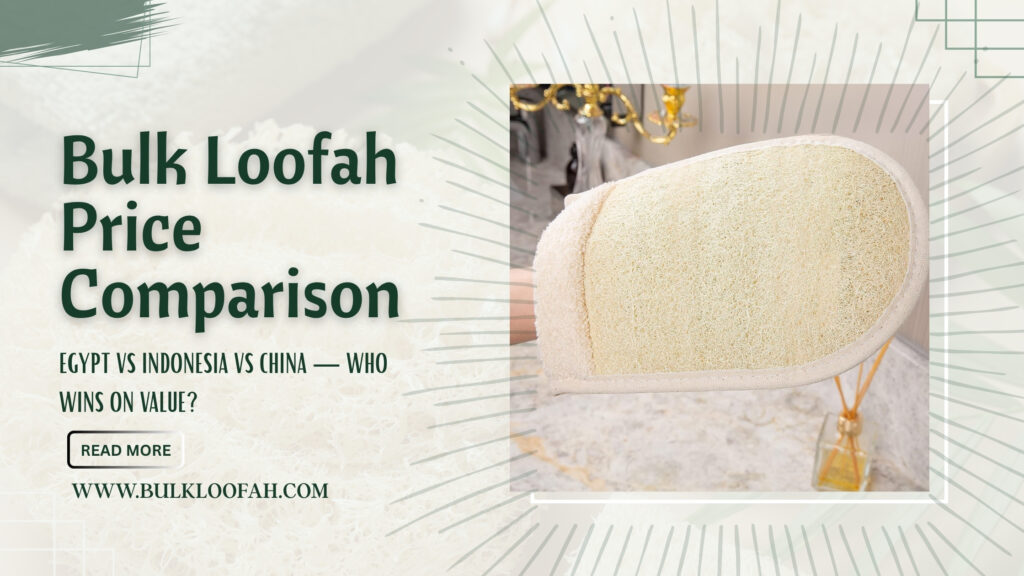
When sourcing natural loofahs in bulk quantities, the choice between Egyptian, Indonesian, and Chinese suppliers can make or break your profit margins. A bulk loofah price comparison by country reveals dramatic differences not just in cost per unit, but in overall value proposition that affects both wholesale buyers and end consumers.
The global natural loofah market has experienced unprecedented growth. This surge stems from rising environmental consciousness among consumers and expanding applications in spa, hospitality, and retail sectors. For wholesale buyers managing procurement budgets and individual consumers seeking premium bath accessories, understanding these regional differences becomes crucial for making informed purchasing decisions.
Whether you’re a spa owner planning your annual inventory, an Amazon seller evaluating product lines, or simply someone wanting to understand what makes Egyptian loofahs command premium prices, this analysis compares what each country offers. We’ll examine quality standards, pricing structures, logistics considerations, and long-term ROI from three major loofah-producing regions.
Understanding Global Loofah Production Landscape
The natural loofah industry centers around three dominant producing regions, each offering distinct advantages and trade-offs. Egypt grows soft, gentle loofah in the Nile Delta. Indonesian production focuses on volume and competitive pricing, while Chinese manufacturers emphasize industrial-scale processing and rapid fulfillment.
Market dynamics significantly influence bulk loofah price comparison by country considerations. EGEXO has been exporting Egyptian loofah since 2015 and checks every product by hand for quality, size and dryness before packing.
Indonesian suppliers capitalize on lower labor costs and favorable climate conditions, producing decent-quality loofahs at competitive price points. Their production model serves budget-conscious buyers while maintaining acceptable quality standards for most applications. Chinese manufacturers leverage advanced processing technology and economies of scale, offering the most aggressive pricing for high-volume orders.
Egyptian Loofah: Soft and Gentle
Egyptian loofah is soft and gentle from the first use, with a looser fiber weave than Asian loofah. EGEXO has been exporting Egyptian loofah since 2015.
The Nile Delta’s climate creates good growing conditions. Egyptian loofah is hand-harvested at peak maturity and dried by sun drying and machine drying. Our standard loofah is not bleached. Bleaching is done only on request.
Individual consumers benefit from the gentle yet effective exfoliation of Egyptian loofah.
Egyptian Loofah Value Proposition Analysis
EGEXO uses four price tiers: 1-499, 500-1,999, 2,000-4,999 and 5,000+ units. See our wholesale prices on egexo.com. The private labeling opportunities available through established suppliers like Egexo add additional value for brand builders seeking differentiation.
EGEXO’s management system is certified to ISO 9001, 14001, 45001 and 22716. Documents we hold: the ISO certificates, Certificate of Origin or EUR.1, Phytosanitary Certificate and Export License.
Indonesian Loofahs: Balancing Quality and Affordability
Indonesian loofah production offers compelling value propositions for buyers seeking balance between quality and cost-effectiveness. The archipelago’s tropical climate supports year-round cultivation, enabling consistent supply chains and competitive pricing structures that appeal to budget-conscious wholesale buyers.
Indonesian suppliers have modernized processing facilities while maintaining sustainable harvesting practices, resulting in standardized products that meet international quality benchmarks. The processing efficiency makes Indonesian loofahs attractive for mid-market retail applications.
For hospitality buyers managing large-volume requirements, Indonesian loofahs provide acceptable quality at price points that support profitable operations. Hotels and resorts often specify Indonesian loofahs for guest amenities, balancing guest satisfaction with operational cost control.
Individual consumers find Indonesian loofahs suitable for regular household use, offering good exfoliation properties and reasonable durability at accessible price points. The quality consistency makes them reliable choices for families and budget-conscious shoppers who prioritize value over premium features.
Indonesian producers excel at meeting specific size requirements and can accommodate moderate customization requests, making them suitable for retailers with defined product specifications. For custom shapes and sizes from EGEXO, see our custom product design service.
Chinese Loofahs: Volume Leaders with Competitive Pricing
Chinese loofah manufacturing dominates global volume production, leveraging industrial-scale processing and aggressive pricing strategies that appeal to high-volume buyers prioritizing cost minimization. The manufacturing infrastructure supports rapid order fulfillment and extensive customization options at competitive rates.
Chinese suppliers often offer lower per-unit costs. This pricing advantage makes Chinese loofahs attractive for promotional applications, budget retail chains, and situations where cost control outweighs premium quality considerations.
The industrial processing capabilities enable Chinese manufacturers to offer extensive size ranges, packaging options, and basic quality grades that serve diverse market segments. For Amazon sellers and online retailers focusing on price-sensitive consumers, Chinese loofahs provide acceptable quality at margins that support competitive retail pricing.
However, quality consistency can vary significantly between suppliers, requiring careful vendor evaluation and quality control processes. Bulk buyers must invest in supplier verification and ongoing quality monitoring to ensure product standards meet customer expectations.
Chinese Manufacturing Advantages and Considerations
Chinese loofah production benefits from established supply chains, efficient logistics networks, and flexible manufacturing systems that can adapt to changing market demands. The ability to process large volumes quickly supports retailers with seasonal fluctuations or promotional campaigns requiring rapid inventory buildup.
Quality control varies widely among Chinese suppliers, with established manufacturers offering consistent products while smaller operations may struggle with standardization. Buyers should prioritize suppliers with quality certifications and established export track records to minimize quality risks.
Environmental and labor standards also vary significantly, making supplier verification crucial for buyers concerned with sustainability and ethical sourcing. Reputable Chinese manufacturers implement quality management systems and maintain international compliance standards, but due diligence remains essential.
Logistics and Import Considerations by Country
Shipping costs and logistics complexity significantly impact total landed costs when conducting bulk loofah price comparison by country analysis. EGEXO quotes in USD, EX-Works Damanhour. EXW, CFR, CIF and DAP are standard; FOB and DDP only on request.
Indonesian logistics benefit from excellent port infrastructure and competitive shipping rates to major markets, though documentation requirements can be more complex than Egyptian exports.
Chinese suppliers offer the most extensive shipping options, including air freight for urgent orders and consolidated sea freight for cost optimization. The mature logistics infrastructure supports flexible shipping terms and competitive rates, though quality control during shipping and handling may require additional oversight.
For EGEXO shipments from Egypt, a full container by sea takes 18-25 days to France and 25-30 days to the USA. A shared container takes about 40 days to France and 45 to the USA. Air takes 2-3 days to the destination airport, and express door delivery takes 4-7 days. Other routes are confirmed in your quote.
Import duties and regulations vary by destination country. Buyers may pay lower or zero import duty on Egyptian loofah with origin papers; please confirm with your customs broker.
For wholesale buyers, working with experienced suppliers who understand international trade requirements proves invaluable. Egexo’s established export processes exemplify how experienced suppliers streamline international transactions and reduce compliance risks.
Quality Standards and Certification Comparison
Quality certification systems vary between producing countries, which affects product reliability and market acceptance. Ask every supplier which documents they hold, and check them.
EGEXO publishes its quality standards openly, and checks every product by hand for quality, size and dryness before packing.
Your return depends on your price, volume tier and sales channel. See our wholesale prices on egexo.com.
Minimum Order Quantities and Scalability
Minimum Order Quantity requirements significantly impact accessibility for different buyer types and influence total cost calculations in bulk loofah price comparison by country scenarios.
At EGEXO there is no minimum order on standard products. Private label starts from 1,000 units (up to 2,000 by customization). Request quotation processes provide detailed pricing based on specific requirements.
Scalability considerations extend beyond pricing to include supply reliability, quality consistency, and relationship management. EGEXO works from its own farms and factory, which supports consistent quality as your business grows.
Market Trends and Future Outlook
The global loofah market continues evolving rapidly, with sustainability concerns driving premium segment growth and technological advances improving production efficiency across all regions. Egyptian producers increasingly emphasize sustainable farming practices, supporting premium positioning in environmentally conscious markets.
Consumer awareness of microplastic pollution enhances natural loofah appeal, with educated buyers willing to pay premiums for authentic natural products. This trend particularly benefits Egyptian and Indonesian suppliers who emphasize natural processing methods over industrial approaches.
E-commerce growth creates opportunities for direct-to-consumer brands, with successful sellers often choosing premium suppliers for product differentiation. The ability to tell authentic sustainability stories becomes increasingly valuable for brand builders and online retailers.
Manufacturing innovations in processing and quality control continue improving consistency and reducing costs across all producing regions. However, Egyptian suppliers maintain advantages through traditional knowledge and optimal growing conditions that technology cannot easily replicate.
Emerging Market Opportunities
Private labeling and custom packaging services gain importance as buyers seek differentiation in competitive markets. Suppliers offering comprehensive branding support, like Egexo’s private labeling services, provide additional value beyond basic product supply.
Sustainability certifications and traceability documentation become standard requirements for premium markets, favoring suppliers with established quality management systems. Buyers increasingly request detailed supply chain information to support their own sustainability claims.
Subscription and repeat-purchase models create opportunities for suppliers offering consistent quality and reliable delivery. Premium suppliers benefit from customer loyalty programs and automatic reorder systems that value quality over lowest price.
Expert Insight from EGEXO
Since 2015 we have exported loofah from Egypt’s Nile Delta, and we’ve seen how quality investments pay long-term dividends for both suppliers and customers. The key to successful bulk loofah procurement lies in understanding your true cost structure beyond initial per-unit prices.
Egyptian loofah is soft and gentle from the first use. For businesses building brand reputation, that quality supports customer retention that budget options cannot match.
Our experience with buyers in more than 40 countries shows that successful buyers focus on total value rather than lowest price. Quality consistency, reliable supply chains, and dedicated customer support create sustainable competitive advantages that drive long-term profitability. You can read how we work on our farm-to-export process page.
FAQ Section
Q1: What are the typical minimum order quantities for bulk loofah purchases from each country?
A: At EGEXO there is no minimum order on standard products. Private label starts from 1,000 units (up to 2,000 by customization). Minimums at other suppliers vary, so ask each supplier.
Q2: How do quality differences between countries affect long-term costs for spa and retail businesses?
A: Quality differences affect how often you replace stock and how many customer complaints you handle. Egyptian loofah is soft and gentle from the first use. Ask each supplier for samples and compare them side by side.
Q3: Which country offers the best value for Amazon sellers and online retailers?
A: Value depends on positioning strategy. Egyptian loofahs support premium pricing and higher margins for quality-focused brands, Indonesian options balance quality and affordability for mid-market positioning, while Chinese loofahs enable competitive pricing for budget-conscious consumers. Consider your target customer and profit margin requirements when choosing.
Q4: What shipping and import considerations should wholesale buyers evaluate?
A: Egyptian exports offer predictable logistics with established freight relationships, Indonesian shipping provides competitive rates but complex documentation, and Chinese suppliers offer flexible shipping options with mature logistics infrastructure. Factor shipping costs, transit times, and documentation complexity into total landed cost calculations for accurate bulk loofah price comparison by country analysis.
Q5: How do certification standards differ between producing countries?
A: Certification standards differ between producing countries. EGEXO’s management system is certified to ISO 9001, 14001, 45001 and 22716. Verify specific certifications match your quality requirements and market positioning needs.
Q6: What factors beyond price should influence bulk loofah sourcing decisions?
A: Consider quality consistency, supplier reliability, customer service support, customization capabilities, certification standards, and long-term relationship potential. Good suppliers offer consistent quality and supply chain transparency that support business growth beyond simple cost savings.
Q7: How do volume discounts compare between different country suppliers?
A: All regions offer volume discounts, but structure varies significantly. EGEXO uses four price tiers: 1-499, 500-1,999, 2,000-4,999 and 5,000+ units, Indonesian pricing scales competitively for mid-range applications, while Chinese suppliers offer aggressive volume pricing but may compromise quality at lowest price points.
Q8: What quality control measures should buyers implement when sourcing from different countries?
A: Establish clear quality specifications, request samples before bulk orders, implement incoming inspection procedures, and maintain supplier scorecards tracking quality performance. Ask every supplier how products are checked before shipping.
Conclusion
The bulk loofah price comparison by country analysis reveals that true value extends far beyond initial per-unit costs. Egyptian suppliers like EGEXO offer soft, gentle loofah and a clear view of the supply chain. Indonesian suppliers provide compelling balance between quality and affordability for mid-market applications, while Chinese manufacturers offer aggressive pricing for budget-focused strategies.
Successful sourcing decisions require comprehensive evaluation of quality standards, logistics costs, supplier reliability, and alignment with business objectives. Premium positioning strategies benefit most from Egyptian sourcing, moderate retail applications often find Indonesian suppliers optimal, and cost leadership models may favor Chinese options with careful supplier selection.
Key Takeaways:
- Egyptian loofah is soft and gentle from the first use
- Indonesian suppliers offer optimal quality-price balance for mid-market retail and hospitality
- Chinese manufacturers provide lowest per-unit costs but require careful quality control and supplier evaluation
- Total landed costs including shipping and logistics significantly impact country comparison calculations
- Quality consistency and supplier relationship quality often matter more than lowest price for long-term success
Ready to experience premium Egyptian loofah quality?
- For Wholesale Buyers: Request a quote or download our catalog
- For Individual Orders: See our products or request samples