
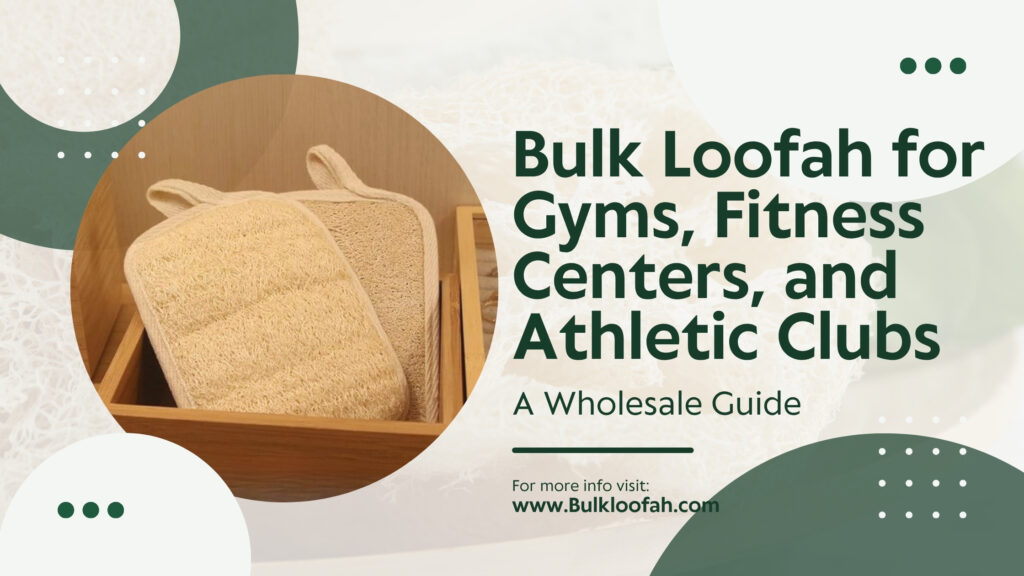
Every day, gym members step into showers expecting clean facilities and quality amenities. The small details matter. One detail that often goes unnoticed yet significantly impacts member satisfaction is the humble loofah. For fitness centers, gyms, and athletic clubs, sourcing bulk loofah supplies isn’t just about purchasing products, it’s about understanding quality standards, managing costs effectively, and ensuring consistent member experience across multiple locations or seasons.
If you’re a gym owner, fitness center manager, or wholesale buyer wondering how to source bulk loofah for your facility, you’re asking the right questions. The loofah market has evolved considerably, with gym and fitness facilities now recognizing loofahs as essential amenities that enhance member satisfaction and retention. Whether you operate a single boutique fitness studio or manage a multi-location franchise, understanding bulk loofah procurement can save operating costs while improving your competitive advantage.
This comprehensive guide addresses both wholesale buyers seeking bulk quantities and individual consumers curious about why quality matters. We’ll explore everything from minimum order quantities and pricing tiers to quality evaluation criteria and supplier selection strategies. By the end, you’ll understand exactly how to source, evaluate, and implement bulk loofah solutions that align with your facility’s needs and budget.
The loofah industry has matured significantly. EGEXO has been exporting Egyptian loofah since 2015 and ships it at scale. Let’s dive into what you need to know.
Understanding the Bulk Loofah Market for Fitness Facilities
Bulk loofah purchasing for gyms differs significantly from retail shopping. Facilities need consistency, durability, and cost-effectiveness across multiple units.
Egyptian loofah is natural and biodegradable, and it is soft and gentle from the first use.
For B2B buyers, understanding market dynamics helps negotiate better terms. EGEXO uses four price tiers: 1-499, 500-1,999, 2,000-4,999 and 5,000+ units. Larger orders receive lower per-unit costs. For individual consumers researching purchases, this information helps contextualize why bulk options offer such significant savings.
Ready to explore bulk options for your facility? Request a quotation for wholesale bulk loofah to understand pricing specific to your facility size and needs.
Quality Standards and Specifications for Gym Loofah Procurement
When sourcing bulk loofah for fitness centers, quality specifications matter tremendously. Not all loofahs perform equally in demanding commercial environments. Understanding what separates premium products from standard options ensures your facility investment delivers consistent results.
Egyptian vs. Other Loofah Sources
Egyptian loofah grows in the Nile Delta. It has a looser fiber weave than Asian loofah, so it is soft and gentle from the first use.
Every EGEXO product is checked by hand for quality, size and dryness before packing. Tell us the size and quantity you need and we quote it.
Bulk Pricing Models and Cost Analysis for Wholesale Buyers
EGEXO uses four price tiers: 1-499, 500-1,999, 2,000-4,999 and 5,000+ units. See our wholesale prices on egexo.com: request a quote.
Supplier Evaluation and Selection Criteria
Choosing the right bulk loofah supplier determines whether your facility receives consistent quality or faces recurring issues with product deterioration.
Essential Supplier Evaluation Checklist
When evaluating potential wholesale suppliers, work through this comprehensive checklist:
Product Quality Assessment
- Verify Egyptian origin and specific cultivation region (Nile Delta is preferred)
- Request samples from three different production batches
- Test loofah durability through 50+ use cycles in actual shower conditions
- Confirm fiber density and structural integrity specifications
- Evaluate color consistency and uniformity across units
- Assess mold and mildew resistance without chemical treatments
Business Credibility and Certifications
- Verify years in business and specific loofah industry experience
- Confirm certifications (ISO 9001, agricultural certifications, export licenses)
- Review third-party quality testing documentation
- Check references from existing gym and fitness center clients
- Evaluate supplier’s track record with on-time delivery
- Assess customer service responsiveness and communication
Pricing and Payment Terms
- Compare per-unit costs across standard order quantities
- Understand volume discount structure and breakpoints
- Clarify payment terms (for example 50 percent advance and 50 percent before shipment, or L/C)
- Verify minimum order quantities and flexibility
- Confirm pricing stability and any surcharge policies
- Understand whether samples or quality assurance testing incurs costs
Logistics and Supply Chain
- Verify warehouse locations and shipping capabilities
- Understand lead times for standard and expedited orders
- Confirm packaging quality (loofahs should arrive in clean, protective materials)
- Evaluate customs clearance expertise for international orders
- Understand return policies for defective units
- Assess inventory availability for consistent reordering
Customization and Support Services
- Inquire about private labeling options for brand differentiation
- Understand custom product design capabilities
- Verify technical support for storage and care recommendations
- Assess whether supplier offers training materials for staff
- Evaluate educational resources about loofah benefits and usage
Facilities that invest time in thorough supplier evaluation typically experience fewer disruptions and better value over multi-year relationships.
Why Egexo Stands Out in the Market
EGEXO has been exporting Egyptian loofah since 2015. Our loofah comes from our own farms and partner farms in the Nile Delta and is processed in our own factory.
For gyms and fitness centers specifically, Egexo offers:
- Direct Egyptian sourcing with verified quality standards
- Competitive bulk pricing with transparent tiering
- Reliable lead times and inventory management
- Expert support for facility-specific applications
- Private labeling and custom design capabilities
When evaluating suppliers, request samples and conduct your own durability testing.
Explore Egexo’s complete loofah product line and wholesale options to understand their full range of solutions for fitness facilities.
Logistics, Ordering, and Implementation Strategy
Moving from decision to implementation requires understanding logistics and operational considerations specific to bulk loofah procurement.
Minimum Order Quantities and Lead Times
At EGEXO there is no minimum order on standard products. Private label starts from 1,000 units (up to 2,000 by customization). Lead time is 7 to 25 days from payment; custom orders take longer and we confirm the time with your quote.
For fitness facilities, planning quarterly or semi-annual orders around consumption patterns helps secure better pricing while managing storage logistics.
Storage and Inventory Management
Loofahs require proper storage to maintain quality:
- Store in cool, dry environments (50-75 degrees Fahrenheit ideal)
- Maintain humidity below 60 percent to prevent mold
- Use breathable storage containers, not sealed plastic
- Keep away from direct sunlight and heat sources
- Rotate stock using FIFO (first-in, first-out) methodology
- Inspect inventory monthly for any quality degradation
Distribution Across Multiple Facilities
For chains managing multiple locations, centralized ordering with distributed fulfillment optimizes costs. Consolidating orders from 10 locations (requiring 2,500 loofahs total) qualifies for significantly better pricing than individual location orders.
Implement these distribution best practices:
Centralized ordering reduces per-unit costs and simplifies vendor management. Coordinate all locations to order simultaneously, unlocking volume pricing.
Hub-and-spoke distribution involves receiving bulk orders at a central warehouse, then distributing to individual locations. This approach requires additional logistics but ensures consistent product and pricing across the entire facility network.
Standardized reordering means all locations request loofah supplies through the same schedule and process, preventing fragmented ordering that loses volume discounts.
Staff training and deployment requires educating facility managers about proper loofah storage, restocking procedures, and member communication about amenity care.
Quality Assurance Upon Delivery
When bulk loofah shipments arrive, implement a receiving protocol:
- Verify shipment against purchase order for quantity accuracy
- Inspect sample of loofahs (minimum 5 percent of order) for quality defects
- Test structural integrity by gently squeezing several units
- Assess color consistency and uniformity across samples
- Document any defects or damage immediately
- Confirm packaging integrity and absence of moisture damage
- Photograph and report any significant issues to supplier within 48 hours
- Store loofahs properly per supplier guidelines
- Tag inventory with receipt date for FIFO rotation
- Establish baseline quality expectations for ongoing orders
This process protects your facility from receiving substandard products and establishes documentation for any quality disputes with suppliers.
Comparing Loofah Types for Fitness Facility Applications
Natural Egyptian loofah is biodegradable and does not shed microplastics, unlike synthetic scrubbers.
Explore Egyptian loofah options optimized for commercial gym applications: Browse bulk body and bath loofahs designed for high-use environments.
Sustainability and Environmental Considerations
Modern gym members increasingly prioritize sustainability in facility choices. Loofah sourcing reflects facility values and contributes meaningfully to environmental impact.
Natural vs. Synthetic Environmental Impact
Egyptian natural loofahs are 100% biodegradable and need no petroleum-based inputs. This contrasts sharply with synthetic alternatives that persist for decades while shedding microplastics.
For gyms marketing themselves as environmentally conscious, premium Egyptian loofahs provide a tangible sustainability narrative. Members using natural loofahs from sustainable Egyptian farms contribute to preserving Nile Delta agriculture and supporting farming communities.
Sustainable Sourcing Verification
When evaluating suppliers, confirm sustainability claims:
- Verify Egyptian origin through import documentation
- Confirm cultivation practices avoid harmful pesticides
- Assess water usage during farming and processing
- Understand waste management in manufacturing
- Verify worker welfare standards in production facilities
- Confirm biodegradability and environmental certifications
Suppliers like Egexo maintain transparent farm-to-export processes that allow facilities to confidently communicate sustainability to members.
Communicating Sustainability to Members
Gyms incorporating premium loofahs can leverage sustainability messaging:
“Our facility features premium Egyptian loofahs, 100 percent natural and sustainably harvested. Unlike synthetic alternatives, natural loofahs biodegrade completely, eliminating microplastic pollution. By choosing our facility, you’re supporting sustainable agriculture in Egypt’s Nile Delta region while using superior products.”
This messaging strengthens brand positioning while educating members about product choices and environmental responsibility.
Learn more about Egexo’s farm-to-export sustainability process to understand how ethical sourcing creates measurable environmental benefit.
Expert Insight from EGEXO
Since 2015 EGEXO has exported Egyptian loofah. Gyms and fitness centers are a demanding commercial application for loofahs: humid showers, frequent washing, and heavy daily use. We recommend that facilities test samples in real gym use before committing to large orders. Every product is checked by hand for quality, size and dryness before packing. See how we work.
FAQ Section
Q1: How should I care for loofahs in a gym environment?
A: Rinse a loofah after use, let it dry between uses, and replace it when it starts to break down or smell. Store spare stock in a dry, ventilated space.
Q2: How do I calculate the right bulk loofah quantity for my facility?
A: Start with monthly member visits and estimate how many members use a loofah each month. Multiply by how often you replace stock, and add a buffer. Send us your numbers with a quote request.
Q3: How should shared gyms care for natural loofahs?
A: Rinse natural loofahs after each use and let them dry in a ventilated space. Replace them when they start to break down or smell.
Q4: What’s the difference between bulk and wholesale loofah pricing?
A: Bulk purchasing means ordering large quantities of the same product at reduced per-unit rates. Wholesale pricing refers to pricing structures designed for business resellers, distributors, and retailers. At EGEXO there is no minimum order on standard products, and prices fall at each of four tiers: 1-499, 500-1,999, 2,000-4,999 and 5,000+ units.
Q5: Can I order different loofah sizes in a single bulk order?
A: Most suppliers offer flexibility on size variation within bulk orders. You might order 2,500 large loofahs and 2,500 medium loofahs in the same shipment without losing volume pricing. However, confirm this with your supplier, as some charge marginal premiums for mixing sizes. For consistency, many facilities standardize on one size.
Q6: What storage conditions preserve loofah quality during extended inventory holding?
A: Store loofahs in cool (50-75 degrees Fahrenheit), dry (below 60 percent humidity) environments. Use breathable storage containers like mesh bags or cardboard boxes, never sealed plastic. Ensure good air circulation around inventory. Avoid direct sunlight and heat sources.
Q7: How are Egyptian loofahs priced compared to alternatives?
A: Prices depend on the product and the volume tier, so request a quote to compare. Egyptian loofah is soft and gentle from the first use.
Q8: How can I get samples before committing to bulk orders?
A: Samples are paid and the buyer pays shipping. The sample cost is credited to your first order of $1,000 or more, placed within 60 days. Request samples of Egyptian loofahs from reputable suppliers like Egexo to test durability in your actual gym environment before placing large orders.
Conclusion
Bulk loofah procurement for gyms and fitness centers represents a significant opportunity to reduce operational costs while improving member satisfaction and facility differentiation. The choice between premium Egyptian loofahs and budget alternatives carries far greater implications than simple per-unit pricing suggests.
The evaluation process matters tremendously. Requesting samples, conducting durability testing, and thoroughly vetting suppliers based on quality standards, certifications, and customer references prevents costly mistakes. A facility that invests time in proper supplier selection typically experiences smoother operations, better product consistency, and stronger confidence in vendor partnerships.
For sustainability-conscious facilities, premium Egyptian loofahs provide a meaningful story to share with members. Natural, biodegradable loofahs from sustainable Egyptian sources communicate facility values while delivering superior product performance. This combination strengthens brand positioning and member retention.
Key Takeaways:
- Egyptian loofah is natural, biodegradable, and soft and gentle from the first use
- Proper supplier evaluation through samples, certifications, and reference checking prevents quality issues and ensures consistent supply
- Natural loofahs provide sustainability advantages compared to synthetic alternatives
- Multi-location facilities can unlock the most favorable pricing by consolidating orders across all facilities
Ready to experience Egyptian loofah quality?
For Wholesale Buyers: Request a bulk quotation for your facility or download our complete product catalog to explore options.
For Individual Orders or Sample Testing: See our products or request samples to evaluate quality before making facility-wide commitments.
For customization inquiries, multi-location coordination, or private labeling options: Tell us about your facility to discuss your specific facility requirements.