
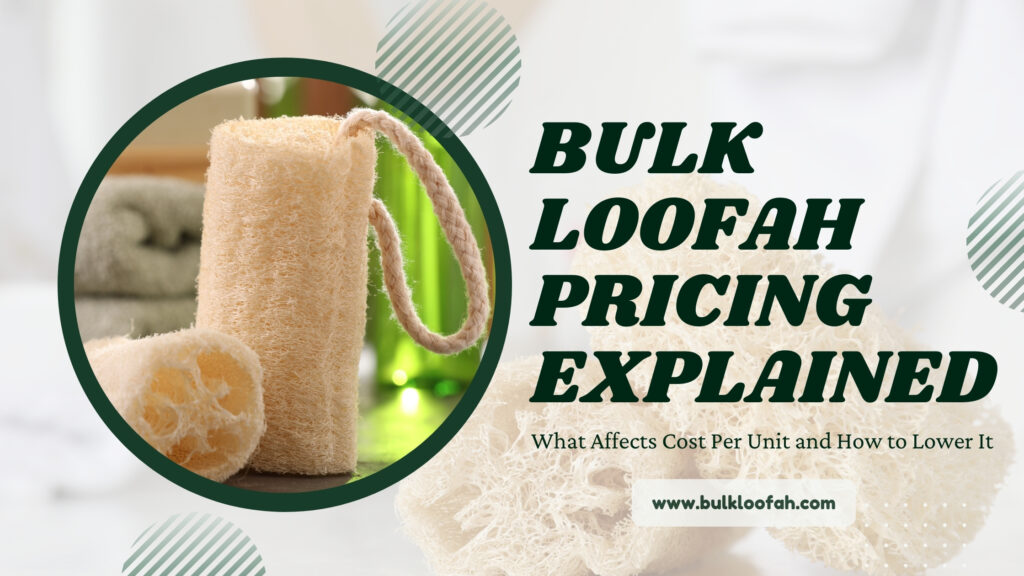
Most buyers ordering loofahs in bulk for the first time hit the same wall. They collect quotes from several suppliers, and the prices are all over the place. One offers a cost per unit that seems almost suspiciously low. Another charges considerably more for what looks like the same product on paper. The frustration is real, and it is completely avoidable once you understand what is actually driving those numbers.
Bulk loofah pricing cost per unit is not a fixed or arbitrary figure. It reflects a chain of decisions made long before any product reaches your hands, starting at the farm, running through processing and quality control, and ending with packaging and logistics. Whether you are a spa owner placing your first large order, a retail brand building a private label product line, an Amazon seller calculating margins, or simply someone trying to understand why a natural loofah costs what it does, every factor in this guide applies to you.
The global demand for natural and eco-friendly personal care products has grown significantly over recent years. Loofahs sit right at the center of that movement, and suppliers with real depth of experience are the ones who understand pricing at every tier. EGEXO, which has exported Egyptian loofah since 2015, has watched buyers become more informed and more selective across every market segment.
This guide walks through every variable that shapes your cost per unit, shows you where real savings are possible, and gives both wholesale buyers and individual consumers the knowledge to make smarter decisions at every purchase level.
What Goes Into Bulk Loofah Pricing Cost Per Unit
Every price on a loofah, whether you are buying one or one hundred thousand, reflects a series of upstream decisions. The raw material source, cultivation practices, processing methods, and quality sorting all feed directly into the final number. Understanding each layer removes the guesswork from any quote you receive.
The Origin of the Raw Material
Where a loofah is grown is one of the most significant pricing factors, and it is also the most misunderstood. Egyptian loofah, particularly from the Nile Delta region, is soft and gentle from the first use, with a looser fiber weave than Asian loofah.
Soft loofah means fewer customer complaints and returns across every category from bath and body loofahs to kitchen scrubbers.
Processing, Cleaning, and Drying Standards
After harvest, raw loofah goes through cleaning, drying, cutting, and quality sorting. EGEXO dries loofah by sun drying and machine drying. Our standard loofah is not bleached. Bleaching is done only on request.
The farm to export process matters because it determines whether the product you receive months after ordering will perform the way it should. Buyers who focus solely on the lowest price often end up with product that breaks down quickly, smells unusual, or carries residue that creates problems for their customers.
Labor and Craftsmanship in the Production Chain
Hand-trimming, sizing consistency, and quality sorting are labor-intensive steps that distinguish a well-made bulk loofah from a poor one. Labor costs vary by country of origin and by how much manual oversight is applied at each production stage. This is a line item that appears in every quote, whether itemized or not, and it is worth asking about when evaluating suppliers.
Check the Quality Before You Order
Before committing to any volume order, testing quality firsthand is essential. You can request loofah samples directly from Egexo and check the size, color, and feel before your procurement decision is made.
The Factors That Move Your Cost Per Unit Up or Down
Once you understand how a loofah is made, the pricing variables become much more predictable. These are the factors that have the most direct effect on what you actually pay per unit.
Order Volume and Minimum Order Quantities
Volume is the strongest lever in bulk pricing. The more units you order, the more fixed costs like export documentation, packaging setup, and logistics coordination are spread across the total quantity. This is why wholesale buyers at higher tiers consistently pay a lower cost per unit than small-scale buyers.
EGEXO uses four price tiers: 1-499, 500-1,999, 2,000-4,999 and 5,000+ units, with no minimum order on standard products. The more units you order, the lower the price per unit.
Customization, Packaging, and Private Labeling
Customization adds cost, but it also adds retail margin. Buyers who want branded packaging, custom cut sizes, or specific product shapes need to account for tooling and setup time in their unit economics. That cost is real, but so is the ability to charge a premium retail price for a branded product.
Private label loofah manufacturing through a direct manufacturer gives brands control over their product without the overhead of running their own production. For buyers who want something more distinct, custom loofah product design services allow for full differentiation in competitive retail markets. The added cost per unit in either case is an investment in margin, not an unnecessary expense.
Shipping, Freight, and Import Costs
The factory price and the landed cost are two different numbers, and confusing them is one of the most common errors in first-time bulk procurement. Freight, insurance, port handling, and customs duties all add to what you actually pay once the product reaches your warehouse. These figures vary based on your origin country, destination, and the Incoterms agreed upon with your supplier.
FOB pricing, common in international loofah trade, means the supplier covers costs until goods are loaded onto the vessel. Everything from that point forward falls to the buyer. Two quotes with different Incoterms are not directly comparable on price alone. Understanding this distinction ensures you are looking at real cost per unit, not just factory price. EGEXO quotes in USD, EX-Works Damanhour. EXW, CFR, CIF and DAP are standard; FOB and DDP only on request.
Certifications and Compliance Requirements
Sustainably sourced or biodegradable labeling can support a higher retail price for brands targeting eco-conscious retail channels or hospitality buyers with documented sustainability commitments. Natural loofah is 100% biodegradable.
Natural Loofah vs Synthetic Alternatives: Cost and Value Side by Side
Some buyers, particularly those new to the loofah market, consider synthetic alternatives as a lower cost per unit option. Understanding the full comparison makes it clear why natural loofah consistently wins in total value.
Natural Egyptian Loofah vs Synthetic Loofah
| Factor | Natural Egyptian Loofah | Synthetic Loofah |
|---|---|---|
| Base Material | Plant-based loofah fiber | Plastic or nylon |
| Exfoliation Quality | Superior, graduated texture | Uniform but harsh |
| Biodegradability | Fully biodegradable | Not biodegradable |
| Environmental Impact | Compostable, zero microplastics | Sheds microplastics during use |
| Cost Per Unit at Scale | Moderate, decreases with volume | Lower upfront |
| Consumer Perception Trend | Strongly positive, growing | Declining due to sustainability concerns |
| Hotel and Spa Suitability | Preferred and expected | Increasingly rejected |
| Retail Market Trend | Growing demand across all channels | Stagnating in premium segments |
Buyers who understand the environmental impact of synthetic scrubbers often choose natural loofah instead.
How to Lower Your Bulk Loofah Cost Per Unit: A Practical Approach
Understanding what drives cost is the foundation. Knowing how to use that understanding to negotiate better terms and structure smarter orders is where the real financial benefit comes in.
Step-by-Step Process for Reducing Cost Per Unit
| Step | Action | Expected Outcome |
|---|---|---|
| 1 | Define the product, size and packaging you need before requesting quotes | Prevents overpaying for features your application does not need |
| 2 | Calculate your actual volume needs across 6 to 12 months | Allows you to place fewer, larger orders and unlock better pricing tiers |
| 3 | Request physical samples before any bulk commitment | Eliminates quality mismatches that lead to costly returns |
| 4 | Compare quotes with the same Incoterms (EXW, CFR, CIF, DAP) | Gives you an accurate landed cost for each supplier |
| 5 | Agree payment terms early (50% advance and 50% before shipment, or L/C) | Enables larger orders and better pricing over time |
| 6 | Consolidate SKUs where possible | Reduces setup costs and simplifies packaging |
| 7 | Plan seasonal orders well in advance | Avoids rush shipping premiums that inflate your effective cost per unit |
| 8 | Work directly with a manufacturer, not a trading company | Removes middleman margin from every order |
Working directly with a manufacturer like Egexo rather than through an intermediary typically yields a meaningful reduction in cost per unit, because you are removing a layer of markup from the supply chain entirely. You can request a bulk wholesale quote directly and compare the result against any trading company quote you have already received. The complete product catalog includes specifications across bath, kitchen, raw, and specialty product lines.
Evaluating a Loofah Supplier Before You Commit
Price is one dimension of a procurement decision. A supplier offering an unusually low cost per unit can become very expensive when quality failures, delayed shipments, or poor communication enter the picture. This checklist gives buyers a structured way to evaluate any supplier before placing a significant order.
Supplier Evaluation Checklist
| Criteria | What to Look For | Why It Matters |
|---|---|---|
| Years in business | Minimum 5 to 10 years | Operational stability and accumulated expertise |
| Direct farm access | Grows or sources from documented farms | Quality control starts at origin |
| Sample availability | Physical samples available before bulk commitment | Validates quality claims before financial exposure |
| Export certifications | Proper documentation for your import requirements | Legal compliance and smooth customs clearance |
| Communication responsiveness | Under 24 hours for initial inquiries | Reflects operational professionalism |
| MOQ flexibility | Willingness to work within your order size | Practical for brands in early scaling phases |
| Private label capability | In-house branding and packaging options | Future-proofs your supplier relationship |
| Verifiable references | Documented buyer testimonials or case studies | Independent validation of supplier claims |
EGEXO has been exporting Egyptian loofah since 2015. It works from its own farms and partner farms in the Nile Delta and its own factory, and offers the full range of product options including raw loofah scrubbers and pet and spa grooming products.
Product Specifications Buyers Need in Every Order
Getting specifications in writing before placing an order is not bureaucratic overhead. It is the single most effective way to prevent disputes, delays, and quality surprises at delivery.
Buyers placing their first import order should request full specification sheets as part of any quotation. These documents create a contractual quality baseline and give you the ability to verify delivery against agreed standards.
FAQ Section
Q1: What is the average bulk loofah pricing cost per unit when ordering wholesale?
Bulk loofah pricing cost per unit varies based on order volume, product type, and whether private labeling or custom packaging is included. EGEXO uses four price tiers: 1-499, 500-1,999, 2,000-4,999 and 5,000+ units. The most accurate figure comes from requesting a direct quote at egexo.com/get-quotation-loofah-wholesale with your specific volume and specifications included.
Q2: What is the minimum order quantity for bulk loofah purchasing?
MOQ varies by supplier and product type. At EGEXO there is no minimum order on standard products. Private label starts from 1,000 units (up to 2,000 by customization).
Q3: Why choose Egyptian loofah?
Egyptian loofah from the Nile Delta benefits from rich alluvial soil, a warm and consistent climate, and a long growing season. It has a looser fiber weave than Asian loofah, so it is soft and gentle from the first use. EGEXO sources from its own farms and partner farms in the Nile Delta.
Q4: How does private labeling affect the bulk loofah cost per unit?
Private labeling adds a cost premium to the base product price, primarily due to custom packaging design, print setup, and often a higher required MOQ. That premium is consistently offset by the higher retail price a branded product commands in the market. Egexo’s private label loofah manufacturing service includes support for design, compliance documentation, and packaging, giving brands a streamlined path from concept to shelf-ready product.
Q5: What is the difference between raw loofah and processed loofah in terms of pricing?
Raw loofah is the dried, uncut fiber in its natural state after harvest and basic cleaning. Processed loofah has been cut to specific dimensions, finished, and packaged for retail or end use. Raw loofah carries a lower cost per unit but requires the buyer to manage further processing. Finished loofah is priced higher because the additional labor and production stages have already been completed, making it ready for direct sale or brand application.
Q6: How can I verify loofah quality before placing a large bulk order?
Requesting physical samples before any bulk commitment is the most reliable method. Reputable suppliers like Egexo provide a structured sample ordering process that lets buyers check size consistency, color, and feel firsthand. This single step prevents the vast majority of quality-related disputes in bulk loofah procurement and should be standard practice for any serious buyer.
Q7: Are natural loofahs genuinely eco-friendly compared to synthetic scrubbers?
Yes. Natural plant-based loofahs are fully biodegradable and compostable at the end of their useful lifespan. Synthetic scrubbers, made from plastic or nylon, shed microplastics during every use and do not decompose in landfills. For eco-conscious consumers and brands targeting sustainability-focused retail channels, natural loofah is the only credible option. That environmental advantage is increasingly a selling point that supports a higher retail price point and stronger customer loyalty.
Q8: What should hospitality and hotel buyers prioritize when sourcing bulk loofahs?
Hotel and hospitality buyers should prioritize strict size consistency. Guests immediately notice inconsistencies in product quality, and a substandard loofah reflects directly on the property. Hygiene documentation, moisture-controlled packaging, and clear compliance records are also essential for hotel procurement standards. EGEXO checks every product by hand for quality, size and dryness before packing.
Expert Insight from EGEXO
At EGEXO, exporting Egyptian loofah since 2015 has taught us one consistent lesson: buyers who take time to understand the true cost structure make far better long-term decisions than those who optimize purely for the lowest quoted price. Our loofah comes from our own farms and partner farms in the Nile Delta and is processed in our own factory. When you work directly with the exporter, you remove the margin layers and quality uncertainty that come with trading companies and intermediaries. Our advice to every wholesale buyer is practical: request samples, compare them side by side under real conditions, and calculate your landed cost rather than your factory price. The buyer who pays a few cents less per unit from an inconsistent supplier and the buyer who pays a fair price for consistent product on reliable delivery schedules are in very different businesses twelve months later. To start, request a quote.
Conclusion
Understanding bulk loofah pricing cost per unit becomes straightforward once you see the variables clearly. Origin quality, processing standards, order volume, customization requirements, and logistics costs each play a measurable role in every quote you receive. Egyptian loofah, sourced directly from the exporter, gives you a clear view of price and quality.
For brands, retailers, and hospitality buyers, the path to lower cost per unit runs through higher volume commitments, fewer SKUs, direct supplier relationships, and sample evaluation before any large purchase. For individual consumers, the same understanding helps explain why premium natural loofahs are priced the way they are and why they consistently outperform cheaper alternatives over time.
Key Takeaways:
- Origin defines value: Egyptian loofah from the Nile Delta is soft and gentle from the first use
- Volume is your strongest pricing lever: moving up a quantity tier consistently delivers meaningful cost per unit reductions
- Landed cost, not factory price, is the number that actually matters in wholesale procurement
- Product selection should be driven by your end use case, not by the lowest available option
- Working directly with the exporter removes middleman costs and quality uncertainty from every order
Ready to put this knowledge to work?
For Wholesale Buyers: Request a bulk quote or download the complete product catalog to review specifications across the full product range.
For Individual Shoppers: See all EGEXO products or request samples to experience Egyptian loofah quality firsthand before committing to a larger purchase.